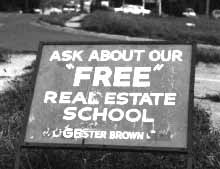
|
Apparently the dunces who composed and approved and published this
sign for all to see think that you stress a word by putting quotes around
it. How do these things get started, and how can we stop them? |
| B A R E L Y B A D W E B S I T E |
|
Free Quotes |
|
|
Apparently the dunces who composed and approved and published this
sign for all to see think that you stress a word by putting quotes around
it. How do these things get started, and how can we stop them? |
|
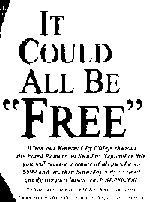
This headline is from a quarter-page ad in The Kansas City Star of September 6, 2001. Forget that the opening double-quote mark is upside down. If you have trouble remembering how they should look, it's simple: Just remember 69. Even forget the main point, which is that they meant it is free, whereas what they said is the opposite, that it's not really free at all. If you owned stock in this company, would you be satisfied with this level of performance from the copywriters? Are they not saying, "We're idiots"? |
|
When our Kansas
City Chiefs shutout [sic] No purchase necessary. What they're saying is that if the Chiefs shut out the Raiders, they'll give you back your money if you spent at least $600 at their store. Now, here's what's funny. First, although they do bother to mention an ending date for qualifying purchases, they do not mention a starting date, which to me means that that camcorder I bought from this store back in 1984 still qualifies. As I read this, if the Chiefs shut out the Raiders this store will rebate purchases over $600 from the day it opened till now. Incidentally, in case you don't know about this, here's how a store or a sponsor can afford such a giveaway. They buy insurance. Insurance companies use actuaries, whose job is to set the price of the premium for various risks. If you want to insure a Honda Interceptor with my insurance company, and if you're the typical buyer of such an extremely fast motorcycle, the actuary will determine that your premium should be $10,000 a year (no kidding). If you want to insure your house and you live on a flood plain and the nearest fire station is twenty minutes away, the actuary will look up the past losses in such situations and tell you it'll cost $2,000 a year. And if you want to insure against losses from a particular sports event -- such as a football game or whether a contestant can hit a hole-in-one in three tries for a dollar -- the actuary will do his math, using the appropriate records, and come up with a price for that bet. The best-known firm that issues this kind of oddball insurance is the famed Lloyd's of London. Second, and much funnier: If no purchase is necessary then how can you get the rebate?
|

|
Here's another one involving "free," from the big sign on the side of a big city truck. Forget that there should be a hyphen between "hassle" and "free. The point is that by putting "HASSLE FREE" in quotes, they're saying that the remodeling really isn't free of hassles, that they don't really mean that part to be taken literally. As with the other two above, they thought that you stress a word by putting quotes around it. How can we "stop" this icky trend? |
|
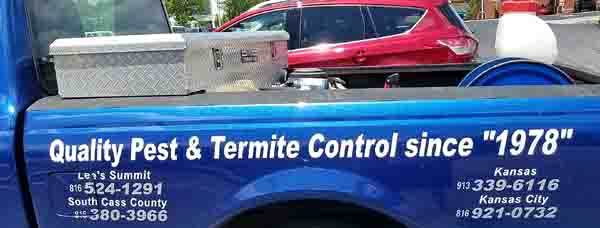
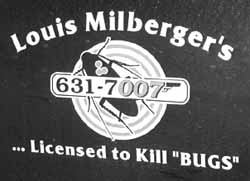
This sign appears on the rear of a vehicle owned by a pest control company. I spotted it parked a few houses away from where I
live. It's not one of those tacky, slap-on, magnetic deals, it's quite professional-looking, and it's kinda' cute once you figure it out.
But, needless to say, the word bugs should not be in quotes (nor, for that matter, should it be in all caps). Also, do you think Louis Milberger is . . . Licensed to Use the "007 Logo" Owned by Eon Productions? Finally, which do you think came first, Milberger's idea to capitalize on the James Bond movies or the particular phone number the phone company randomly assigned him? |
|
Here are two more examples of unnecessary quotes I spotted within one day of each other. Both also happen to be around the same word, and both are from places you'd think would know better.
What NPR means in the paragraph above is exactly the opposite of what they said. They meant to say that Renner's transcript is unofficial, but because they put it in quotes they made it seem non-unofficial.
Here's the other example, from a Web page of the Vanguard Group, an investment firm.
Here again, but in the opposite direction, they said exactly the opposite of what they meant. They meant to say that a statement printed on Vanguard letterhead is official, but because they put that word in quotes they made it seem unofficial. |
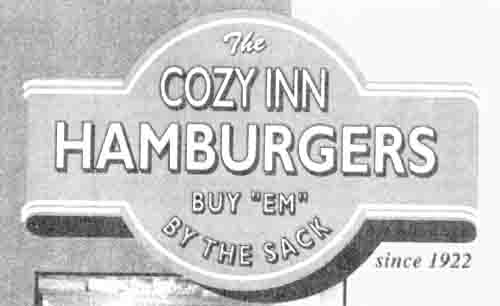 |
This scan comes from a photograph in the March 7, 2002. edition of The Kansas City Star. The photo is of the sign outside The Cozy Inn, a diner in Salina, Kansas. |
|
As the text of the accompanying article makes clear, The Cozy Inn has proudly displayed its motto on their signage
for 80 years, and that motto, as you can see, is this: BUY "EM" BY THE SACK Now, I ask you, how much more wrong could you get? I think maybe they meant to say, "Buy 'em by the sack," but who knows? This is my favorite so far. |
|
 |
I found this on a menu on New Year's Eve, 2003. The restaurant refused to let me take this piece of paper with me, but I absconded with it anyway and left a dollar bill in its place. |
There's a lot wrong in these two sentences. Let's look at the second one first.
But those two are trivial and uninteresting errors, whereas the remaining three are not. Back in the first sentence, there's an impressively dense collection of four more errors in just the one two-word phrase "especially unique." To begn with, the writer makes two mistakes with respect to the word unique.
Now, to be sure, a thing can be described as being less than unique, just not more. It's perfectly sensible to say, "The HydroProTecTIonic Shampoo System is nearly unique in that only four other products on the market today contain both naturally proteinated glistenators and hyponetically irradiated revitalizors."
But none of these errors is why I went to the trouble and expense of swiping and scanning this menu for you.
|
|
|
|
|
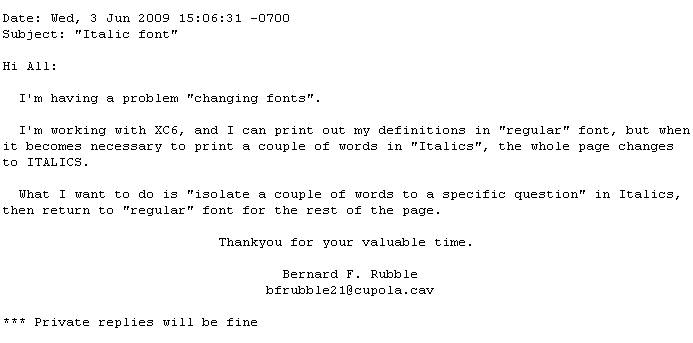
The above is a post to a mailing list I subscribe to. The only changes I've made,
because I am merciful,
are to disguise the identity of the author. Let's start at the bottom and zig-zag our way up. ● There should be a period after the word "fine." ● The collection of three asterisks does not, as you might think, refer to a third referent in the body of the message to a footnote. I'm guessing this ellipsterisk takes the place of "P.S.," but this isn't a postscript at all, it's just one more thought that belongs above the signature. ●● The odd indentation of the closing and the signature really is as shown above: They are centered. Furthermore, the three paragraphs of the body of the message really are indented two spaces. If he were a newbie to computerized communications conventions, Mr. Rubble could be excused, but he's been posting to this list this way for years now. One can only assume he inflicts all these confusing and inconvenient extra spaces on everyone, but maybe not. I just checked, and I received a single email from Mr. Rubble, in 2004. The entirety of the mail is centered, like a formal, engraved wedding invitation. ● Mr. Rubble seems to think Thankyou is a word, I guess, or maybe he knows better and it's merely a typo. As I see it, the occasional pure typo in posts to a mailing list isn't that big a deal as long as it doesn't interfere with the content of the message. Heck, maybe Mr. Rubble knew there should have been a period after "fine." But the rest of the oddnesses are all voluntary. ●●● There's no reason on Earth to capitalize the word italics. This error appears thrice. Oddly, the second one somehow came out in all caps. I'm guessing he was thinking that since you capitalize Italian you should also capitalize italic. ●● At the end of his very first sentence, Mr. Rubble put the period outside the end-quote mark instead of inside of where it belongs, unless he's typing on a British keyboard. Same with the comma after "Italics." ●● The salutation should end with a comma, not a colon. Maybe Mr. Rubble thinks he's supposed to make this look like a typewritten business letter, which might also explain the indented paragraphs (but still not the centered signature or the ellipsterisk), but which is belied by the airy "Hi All," which itself should contain a comma after Hi. ●● I can tell you based on my knowledge of this mailing list that Mr. Rubble has phrased his question quite poorly. Where he says "my definitions," what he's referring to is clues, as in crossword clues. They are never referred to as definitions or, now that I think about it, by any other term. It's always just "clues." Later he refers to a particular clue as "a specific question." Here again, the word "question" is ludicrously not at all the right term. This is a lot of errors in such a short post. As I see it, as the error rate rises the communication rate drops. Furthermore, I suggest that whenever Mr. Rubble exerts so little effort to communicate well, that is disrespectful to the hundreds of people who read this particular mailing list every day. If this post was read just once by 900 people and it confused them to the point where each wasted an average of only 10 seconds before realizing it's hopelessly inscrutable and moved on, that's still 150 minutes of wasted time. By taking the time to write clearly, Mr. Rubble could have saved the world two and a half hours, and he might also have gotten an answer to his question. Whether Mr. Rubble is capable of writing more clearly is debatable, but surely you are. Double quotes. And now we turn, of course, to the double quotes. It's not a mere vaganza, it's a veritable extravaganza. It's important to understand the difference between how Mr. Rubble uses double quotes and how they were used in the examples above. In the examples above, except for the NPR and Vanguard ones, the double quotes were used to indicate emphasis. Mr. Rubble is not using double quotes around certain words and phrases to emphasize them. And he is not using double quotes to quote anything, as in the following correct examples. ● The "festival" consisted of a bassoonist and a lemonade stand. Here the word "festival" is properly in quotes because obviously at some point earlier this collection of a bassoon player and a lemonade stand was referred to as a festival, and the quotes tell us readers to pay attention to that special word, that it shouldn't be taken at face value. ● The "victim" is, as it turns out if you know how the trick is done, a confederate of the magician. Here the double quotes tell us, presumably for the first time, that the person referred to earlier as a victim is not really a victim at all. In these two examples the words are in quotes because the writer decided we needed help in figuring out the meaning of the sentence. The writer figured that if he didn't use quotes, the sentence would have to be re-read to make sense. This use of quotes to draw attention to an unexpected meaning of a term or phrase is not only not bad, it is good. It is the writer foreseeing a potential ambiguity and resolving it for the reader in an efficient and effective way. Think of the quotes as a substutute for the term "so-called." The writer could have typed "The so-called festival consisted of . . . " or "The so-called victim is . . . " and the idea would be exactly the same. In addition to typing, quotes can be signified by gesture and by sound. Air Quotes. This proper use of quotes in type can be mimicked in gesture by using air quotes. You know, where you make quote marks in the air with two fingers of each hand as you say a word. "The repair [make air quotes] shop cracked my engine block while fixing a tire." "Quote End quote." This is yet another proper way to express the idea that a term or phrase should not be taken at face value. Instead of typing quotes or gesturing them, you literally speak them. "The two female reporters were sentenced to 12 years of hard labor in a North Korean prison camp for an otherwise-unspecified quote grave crime end quote against the state" (July 2009). I don't think any other punctuation mark is so often gestured and spoken aloud. Anyway, Mr. Rubble is not using double quotes for this purpose either. He is not warning us to pay special attention to a term because it has an unexpected meaning. I don't know exactly what he's doing, but it is, sadly, not all that uncommon. And whatever it is he's thinking, he thinks it a lot. This little email might not hold the record for the most inexplicable uses of double quotes per word, but it is a contender. Let us count the ways. Here it is again so you don't have to keep scrolling up. Now, starting from the top. |
|
|
|
Dinner plans or "Dinner plans" ● The simple phrase "changing fonts," without the quotes, is a perfectly ordinary phrase, like "changing a tire." If in your soon-to-be-famous novel you have a character merely changing a tire in the rain, which of these would you type? Charlene spent the next hour changing a tire in the rain. or Charlene spent the next hour "changing a tire" in the rain. ●● All of the foregoing applies to Mr. Rubble's quotes around the word regular in the perfectly ordinary phrase "regular font," which he uses twice. ● All of the foregoing applies to Mr. Rubble's quotes around the word Italics. It's just a simple word, like isometrics or electronics. Which would you never type? Charlene knew the electronics of her car would still be OK. or Charlene knew the "electronics" of her car would still be OK. ● Here's my favorite. For some reason known only to him, Mr. Rubble decided to put quotes around the following: "isolate a couple of words to a specific question." I simply cannot imagine what this phrase means. Can you? And I simply cannot imagine why he decided to put the phrase in double quotes. Can you? What criteria could Mr. Rubble possibly be using to decide what to put in double quotes and what not to? Or should I have typed that this way? What criteria could Mr. Rubble possibly be using to decide "what to put in double quotes" and what not to? |
| Update of August 31, 2010: In
today's edition of The Kansas City Star, the main story of
the FYI section is all about typos. These two guys somewhat
famously travel around the U.S. finding typos in signs. When
they find one they photograph it, which is pretty weird if you ask
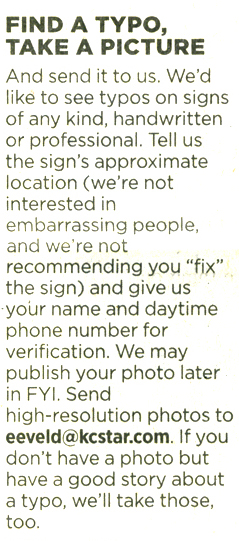
me. Sometimes they try to fix the typos. They use Wite-Out to fix some signs, and they use Sharpies to fix others. Or they get in touch with someone in charge and point out the typo and how to fix it. Please re-read the paragraph above. Is it confusing? Are you baffled as to the meaning of any of the words I used? On page 2 of the article in the Star there's a box, reproduced at right. Apparently my second paragraph should have been typed this way. Sometimes they try to "fix" the typos. They use Wite-Out to "fix" some signs, and they use Sharpies to "fix" others. Or they get in touch with someone in charge and point out the typo and how to "fix" it. As I hope to have made clear, you shouldn't use double quotes unless you have a legitimate reason. Your first instinct should be not to use quotes, unless your knowledge of and facility with the language tell you to make sure you should use them. Especially if you're writing about typo's. |
 |
|
|
What, you don't really mean 1978? |
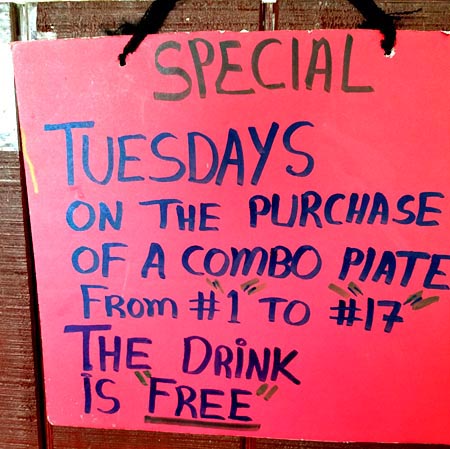 |
I just don't know what all to say about this sign. Obviously the original author had trouble with the letters "I" and "i" and "L," but it's the motive of the person who came along later to add three pairs of pointless double quotes that I can't figure out. |
| B A R E L Y B A D W E B S I T E |
|